Urban Development Consulting for Government Projects: Building India's Cities the Right Way

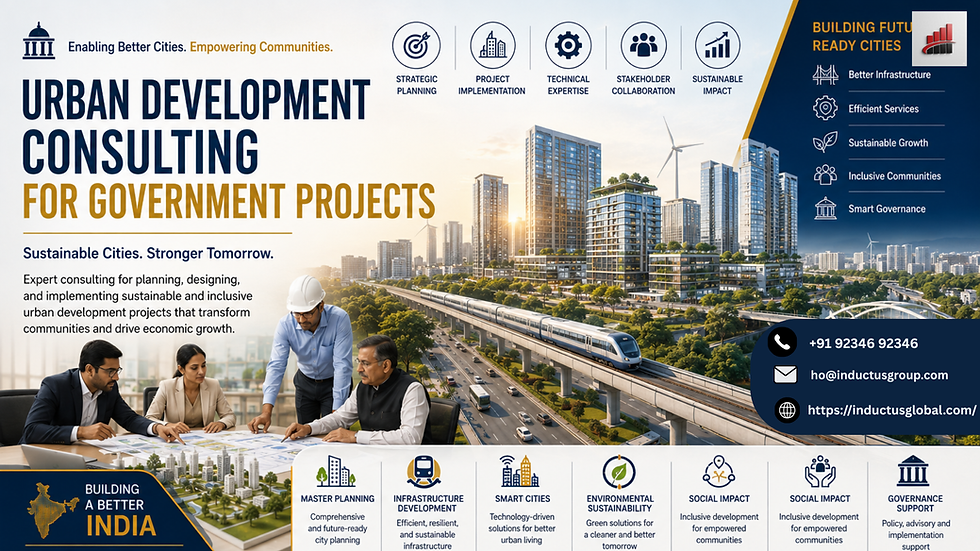
India's cities are expanding faster than almost anywhere else in the world, and government agencies tasked with managing that growth face a familiar challenge: turning ambitious urban plans into livable, functioning infrastructure. This is the space where urban development consulting for government projects plays a critical role — bridging the gap between policy intent and physical, on-the-ground delivery. Inductus Group, a Noida-based consulting and advisory firm with close to two decades of experience, is one of the players positioning itself in this segment.
Why Urban Development Needs Dedicated Consulting Support
Urban development projects rarely move in a straight line. A single initiative — a smart city rollout, a housing scheme, a transit corridor — typically involves multiple government departments, private contractors, land acquisition processes, environmental clearances, and community stakeholders, all operating on different timelines. Without a coordinating layer, even well-funded projects can stall.
That coordinating role is what urban development consulting for government projects is meant to provide: aligning technical planning, regulatory compliance, and execution management so that government-backed urban initiatives actually reach completion rather than getting stuck in inter-departmental handoffs.
Where Inductus Group Fits Into Urban Development Work
Inductus describes its development-sector practice as focused on pioneering urban and rural development through sustainable, technology-enabled solutions, with the stated aim of improving community living standards and supporting economic growth. The firm frames this work around resilient, thriving environments built through careful strategic planning and disciplined execution — language that reflects the two halves of any urban development mandate: designing the right plan, and actually delivering it.
A few elements of the firm's broader operations are directly relevant to urban development consulting:
Infrastructure and engineering capability. Inductus reports active involvement in major EPC (Engineering, Procurement, and Construction) projects, describing infrastructure and engineering as a backbone of economic growth that it supports with multi-disciplinary technical teams — capabilities that map directly onto urban infrastructure builds.
Railways and transit experience. The firm's railway practice covers planning and implementing rail projects, including new line development, station expansion, and workshop modernization — work that frequently overlaps with urban and metro transit planning.
Renewable energy integration. As cities increasingly build sustainability requirements into development plans, the firm's renewable energy consulting arm — covering solar power plant development and power evacuation systems across the full project lifecycle — becomes a relevant piece of the urban development puzzle.
Government-sector track record. Inductus lists public-sector and quasi-government clients such as RailTel, the Ministry of Rural Development (MoRD), and RITES, indicating direct experience navigating government processes at scale.
Full project lifecycle management. The firm's project management services span initiation, planning, execution, monitoring, controlling, and closing — a structure suited to the long timelines typical of urban development work.
What Urban Development Consulting Typically Covers
Drawing on how Inductus positions its development-sector and infrastructure work, urban development consulting for government projects generally spans:
Strategic urban planning — translating government policy goals into actionable development frameworks for specific cities, districts, or corridors.
Infrastructure design and engineering oversight — covering civil works, utilities, and transit infrastructure that underpin urban growth.
Multi-agency coordination — managing the handoffs between municipal bodies, state urban development authorities, and central schemes.
Sustainability integration — incorporating renewable energy and environmental considerations into urban infrastructure from the planning stage rather than as an afterthought.
Execution monitoring — tracking construction and rollout progress against approved timelines and budgets, and flagging risks before they cause delays.
Community and economic impact alignment — ensuring development projects are designed to genuinely improve living standards, not just meet technical specifications.
Why Rural-Urban Integration Matters
One detail worth noting in how Inductus frames its development work: the firm groups urban and rural development together rather than treating them as separate practices. This matters because many government urban development schemes in India — particularly those tied to national missions — are explicitly designed to manage the rural-to-urban transition, not just improve existing city infrastructure. A consulting partner that understands both sides of that transition is generally better positioned to support schemes aimed at planned urbanization rather than reactive, unplanned growth.
What to Look for in an Urban Development Consulting Partner
Government agencies evaluating consultants for urban development projects may want to consider:
Demonstrated EPC and infrastructure delivery experience, not just planning and advisory work
A track record with public-sector and government-linked clients, given the regulatory complexity involved
Cross-sector capability, since urban projects often touch transit, energy, and municipal services simultaneously
End-to-end lifecycle involvement, from initial planning through execution and monitoring
Sustainability expertise, as environmental compliance becomes a bigger factor in project approvals
Final Thoughts
Urban development consulting for government projects sits at the intersection of policy, engineering, and execution discipline — and it's a space that rewards firms with broad, hands-on experience rather than narrow specialization. Inductus Group's combination of infrastructure and EPC capability, government-sector client relationships, and renewable energy integration illustrates the kind of multi-disciplinary approach that large urban development mandates typically require.


Comments